Retail Database Design (SQL)
Normalisation is not bureaucracy — it is the prevention of lies, and the error message is the feature.
- SQL
- MySQL
About this project
A properly normalised database for a small retail shop — customers, products, categories, orders, order lines and payments — with a seed dataset and a file of worked queries you run and read.
The idea it is built around is that normalisation prevents lies. The README starts with one wide spreadsheet-shaped table holding an order and shows the three things that go wrong with it: a customer whose phone number is stored in forty rows and now disagrees with itself, a product that cannot exist until somebody orders it, and deleting the last order of a product erasing the product. Then it takes the same data to 3NF and those three become impossible rather than merely discouraged.
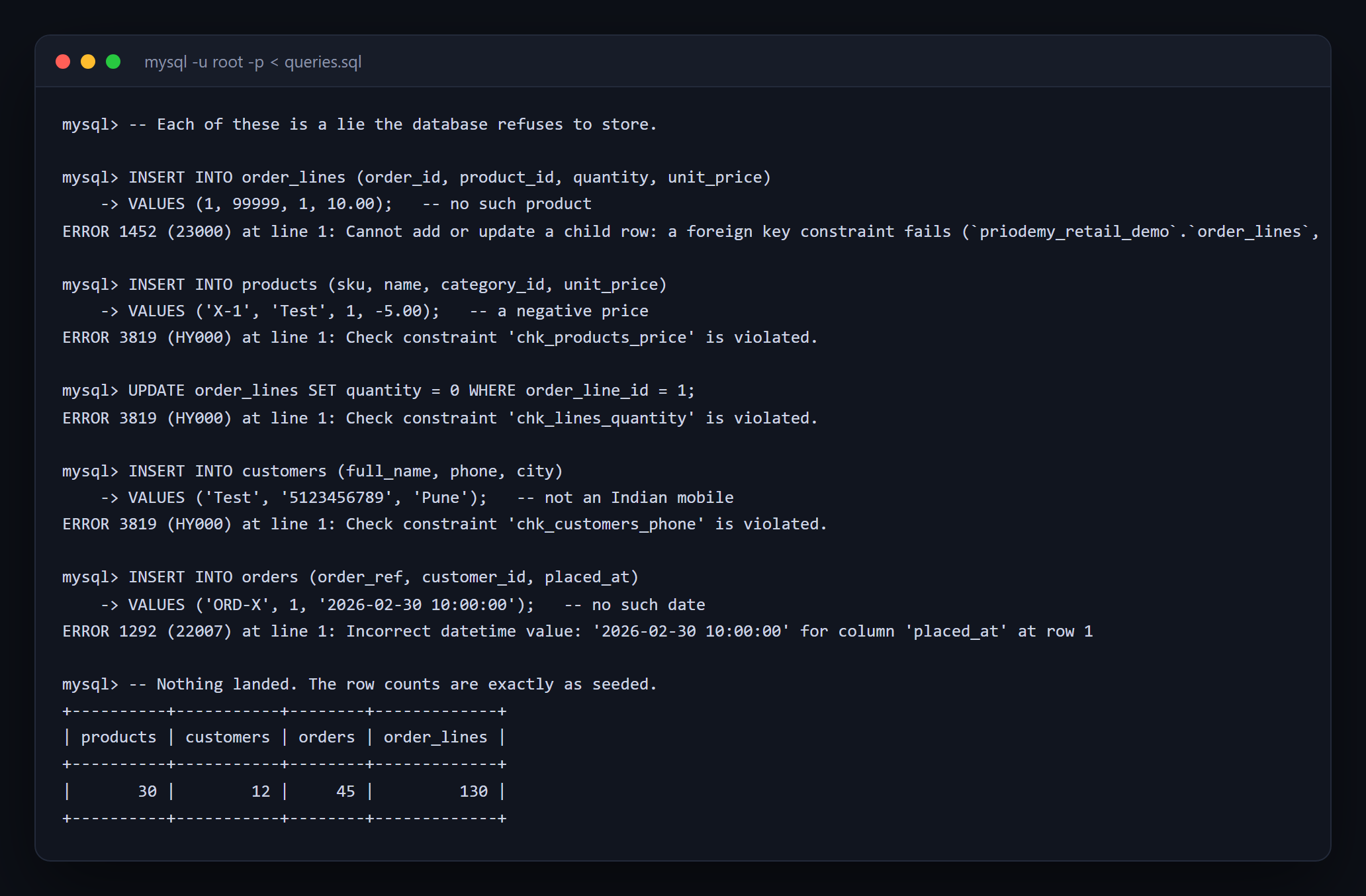
The second theme is that the constraint is the guarantee. The queries file deliberately attempts thirteen bad writes and shows the exact error the database returns each time — because that error, not a comment in your application code, is what actually stops bad data. The demonstrations run inside transactions that roll back, with an assertion at the end proving the row counts are unchanged.
What you will learn
- Take one wide spreadsheet-shaped table to 3NF, and see each anomaly become impossible
- Use FOREIGN KEY, UNIQUE, CHECK and NOT NULL as guarantees the application cannot bypass
- Read EXPLAIN, add an index, and read it again to see what changed
- Store money as DECIMAL and know exactly what FLOAT would cost you
- Understand why an order line records the price at the time of sale, not a join to today’s price
Before you start
- Basic SQL — SELECT, INSERT, and what a table is
- MySQL 8.0.18 or newer. Not MariaDB: CHECK constraints are only enforced from 8.0.16.
New to SQL? The free SQL course covers everything this project assumes.
Academic integrity notice
These projects are provided for learning, experimentation and reference. Understand the code, modify it for your own requirements, and acknowledge external work according to your institution’s academic policies. Priodemy does not supply work to be submitted as your own.
Features
- Seven tables in 3NF with foreign keys, unique keys, CHECK constraints and a generated column
- Thirteen deliberate errors, each showing the exact refusal MySQL returns
- Every demonstration wrapped in a transaction that rolls back, with a proof it did
- The same data as one wide table alongside, so you can compare them query for query
- EXPLAIN before and after an index, plus EXPLAIN ANALYZE for what actually happened
- A realistically shaped seed: 30 products, 12 customers, 45 orders, 130 order lines
Technology stack
Track: Data & Analytics · Level: Starter
What is included
- schema.sql, seed.sql and queries.sql — commented throughout
- A README on the three anomalies, the road to 3NF, and why money is DECIMAL
- A troubleshooting section, and five suggested extensions
Delivered as a 42 KB ZIP. SHA-256 published under Changelog so you can verify it.
System requirements
- Operating system
- Any
- Runtime
- MySQL 8.0.18 or newer. Not MariaDB — the CHECK demonstrations need real CHECK support.
Licence
Learn from it, change it, and use it in your own coursework and personal projects. Do not resell it or pass it off as your own original work.
- Personal and educational use
- Modifying the code however you like
- Using it as the basis of your own coursework, with honest acknowledgement
- Putting your modified version in a portfolio or on your own GitHub
- Reselling or redistributing the project, modified or not
- Presenting it as your own original work
- Commercial deployment — see the Commercial licence
Support window: 6 months from download.
Frequently asked
Why does it need MySQL 8.0.18 and not just "MySQL 8"?
Because the demonstrations depend on features with specific minimums. CHECK constraints are only enforced from 8.0.16 — before that MySQL parses and ignores them, so three of the demonstrations silently invert into successful inserts. EXPLAIN ANALYZE needs 8.0.18. The schema refuses to load on an older server rather than misleading you.
Will it run on MariaDB?
Not as written, and the README says so rather than letting you find out. MariaDB differs on CHECK enforcement and on EXPLAIN ANALYZE, which are the two things this project exists to demonstrate.
Why does an order line store the price again instead of joining to the product?
Because the price of a thing today is not the price it sold for last March. Joining to the product table would silently rewrite the history of every past bill every time you change a price. It looks like duplication and it is not — it is a different fact.
Changelog
- First release
SHA-256206c5daddc276c09282f4e512a0ae481c097ae4c6dbfb943dcc4b45367d75188
You might also like
 Free
Free Data Analysis with pandas
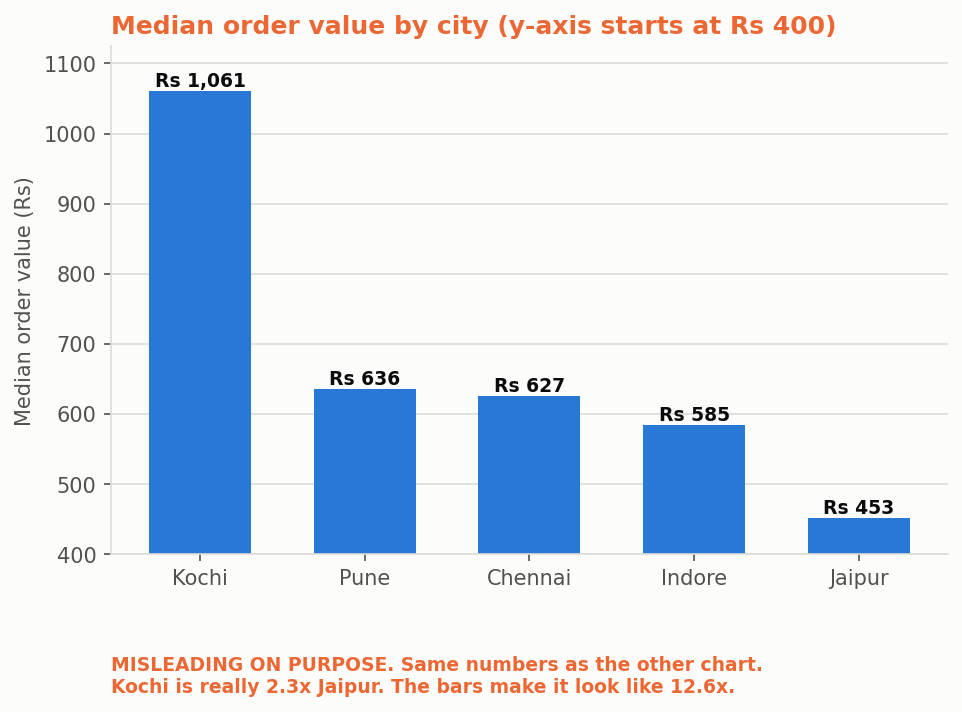
The summary statistic you choose is an argument, not a neutral fact.
- Python
- pandas
- Matplotlib
 Premium
 Report Automation
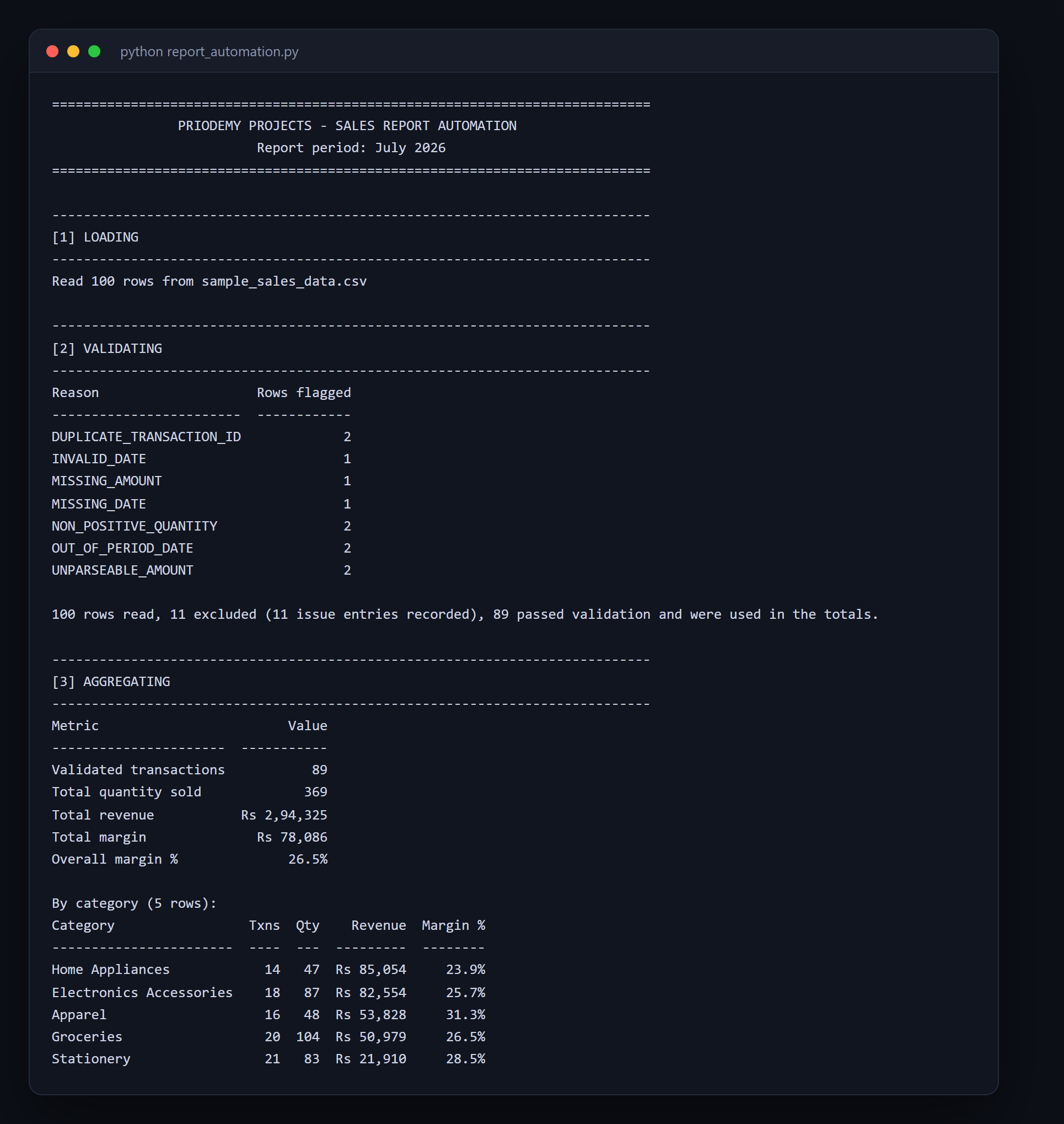
A report that silently trusts its input produces a polished, wrong number — and nobody double-checks a report that looks finished.
- Python
- openpyxl
- pandas
 Pro
Pro Retail Sales Forecasting
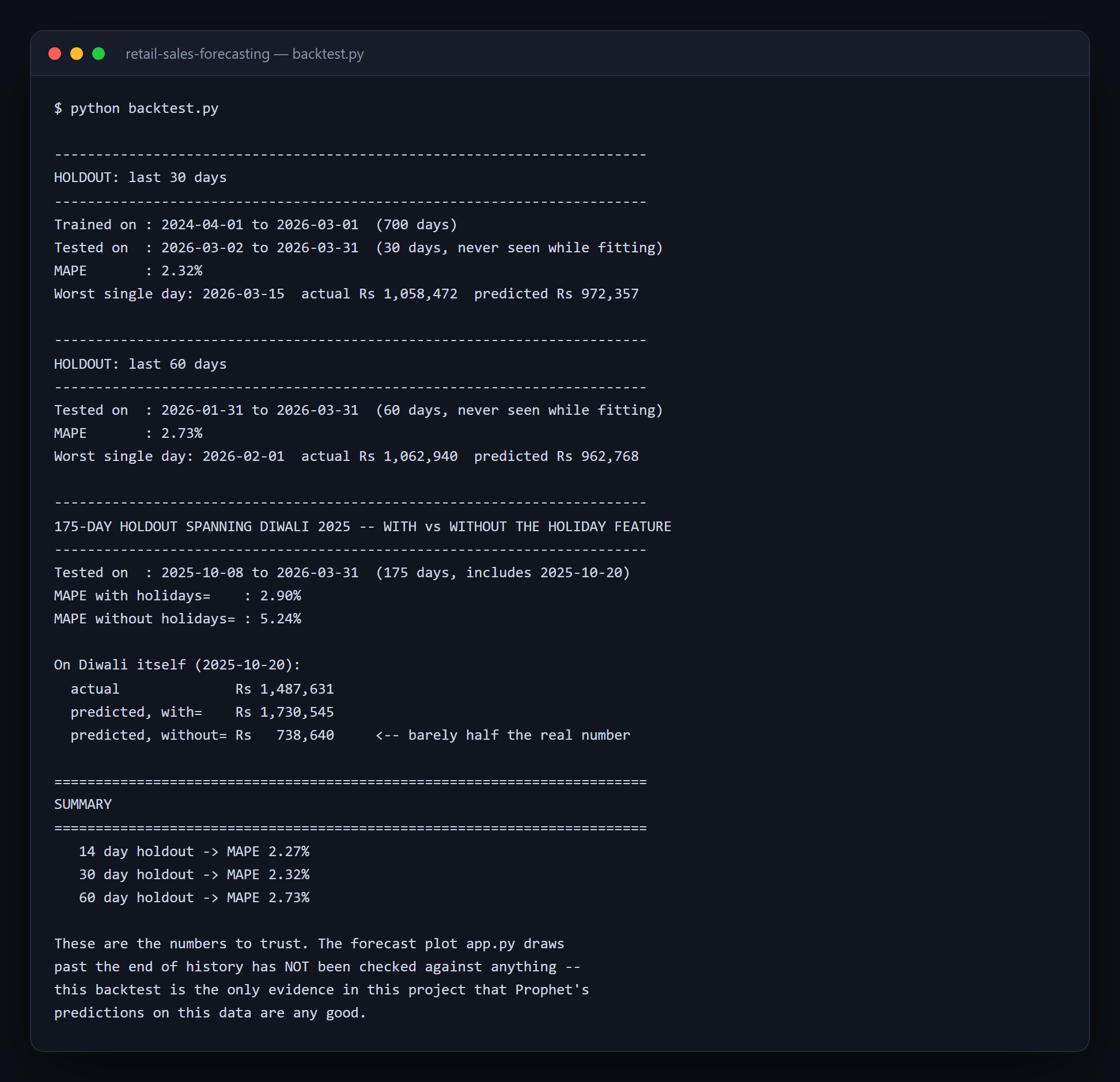
A forecast chart nobody backtested is a drawing — the only honest accuracy number comes from data the model never saw.
- Python
- Prophet
- Streamlit
 Free
Free ATM Simulation System
A working cash machine in Python and MySQL — balance, withdrawal, deposit and a transaction history.
- Python
- MySQL
- mysql-connector